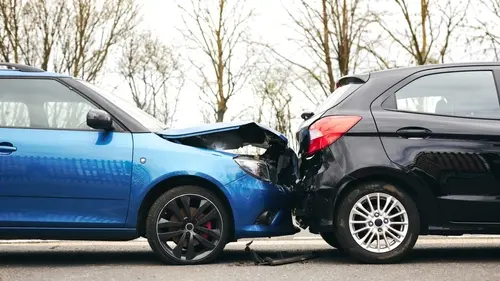
A collision with a tractor-trailer can change your life in seconds. A fully loaded commercial truck can weigh up to 80,000 pounds, about 20 times more than a typical passenger car, so crashes often cause severe injuries. Once the immediate crisis passes, many victims ask the same question: who will pay for my medical bills, lost income, and pain?
The answer is rarely simple. Unlike most car accidents, truck crashes often involve several companies and individuals, each with a role in putting the truck on the road. Determining who is liable in a truck accident means looking closely at the driver, the trucking company, and everyone else connected to the vehicle and its cargo.
At Hodgins & Kiber, our Atlanta truck accident lawyers help injured people pursue compensation.
The Truck Driver May Be At Fault
Truck drivers must hold a commercial driver’s license (CDL) and are expected to meet a higher standard of care than ordinary motorists. A driver may be liable in a truck accident when careless or reckless choices on the road lead to a crash.
Common examples of driver negligence include:
- Speeding or driving too fast for rain, fog, or heavy traffic
- Texting, using a phone, or other distracted driving
- Driving while drowsy or past federal hours-of-service limits
- Driving under the influence of alcohol or drugs
- Following too closely, since a loaded truck needs far more distance to stop
- Unsafe lane changes or failing to check the truck’s large blind spots
- Running red lights or ignoring other traffic laws
Still, the driver is often just one piece of the puzzle. In many cases, the driver’s employer is also responsible for a truck accident.
When Is The Truck Company Liable for a Crash?
Under Georgia law, an employer can generally be held accountable for the negligence of an employee who was acting within the scope of their job. So if a driver causes a wreck while hauling a load, the trucking company may be liable.
Some carriers try to avoid this by labeling drivers as independent contractors. That label does not always protect them. When a driver operates under a carrier’s federal operating authority, the carrier may still be held accountable for that driver’s conduct.
A trucking company can also be directly responsible in a Georgia truck accident case. Examples include:
- Hiring drivers with poor safety records or invalid licenses
- Failing to properly train or supervise drivers
- Pressuring drivers to meet unrealistic delivery schedules
- Encouraging or ignoring hours-of-service violations
- Skipping required inspections and maintenance
- Failing to conduct required drug and alcohol testing
Trucking companies also tend to carry much larger insurance policies than individual drivers. Federal rules require most interstate carriers hauling general freight to carry at least $750,000 in liability coverage, which can make a real difference for victims with serious injuries.

Others Who May Be Liable in a Truck Accident
Behind every commercial truck is a network of businesses that load it, fix it, build it, and maintain the roads it travels. When one of them cuts corners, they may also be held accountable for the crash.
Cargo Loaders and Shippers
Cargo that is overloaded, unevenly balanced, or poorly secured can shift while the truck is moving. That can cause rollovers, jackknife crashes, or loads spilling onto the highway. A shipper or third-party loading company that packed the trailer improperly may be liable in a truck accident, especially if the truck’s driver had no chance to inspect a sealed load.
Maintenance and Repair Shops
Trucks put enormous strain on brakes, tires, and steering systems. Many carriers hire outside shops for repairs and routine service. If a mechanic installs the wrong part, does sloppy brake work, or signs off on a truck that is not road-ready, that shop may be responsible in a truck accident claim.
Truck or Parts Manufacturers
Sometimes the problem starts at the factory. Defective brakes, faulty steering components, and weak trailer couplings can all lead to devastating wrecks. If a defective part contributed to the wreck, the manufacturer may be liable in a Georgia truck accident case.
Government Entities
Road conditions can contribute to truck crashes. Dangerous curves, missing warning signs, broken traffic signals, deep potholes, and poorly managed construction zones may involve the city, county, or state agency responsible for that road. Claims against government entities follow special rules and much shorter notice deadlines.
How Our Atlanta Truck Accident Lawyers Build a Case
Proving who is liable in a truck accident takes evidence, and much of it is in the hands of the trucking company. Some key records only have to be kept for a limited time. For example, federal rules generally require carriers to keep drivers’ hours-of-service records for just six months. That is why acting quickly matters.
One of the first steps an experienced lawyer takes is sending a preservation letter. This formally demands that the trucking company keep all evidence related to the crash. From there, the investigation may include:
- Electronic logging device (ELD) data showing the driver’s hours on the road
- Event data recorder (“black box”) data showing speed, braking, and engine activity before impact
- Driver qualification files, including licensing, training, and past violations
- Drug and alcohol test results
- Maintenance and inspection records for the truck and trailer
- Dispatch records and cell phone records that may reveal schedule pressure or distraction
- Bills of lading and loading records that show who handled the cargo
- Police reports, photos, dashcam footage, and witness statements
In complex cases, lawyers often work with accident reconstruction experts. These specialists use physical evidence and data to explain exactly how the crash happened and who caused it.
The Role of Federal Regulations
Commercial trucking is one of the most heavily regulated industries in the country. The Federal Motor Carrier Safety Administration (FMCSA) sets detailed safety rules for drivers and carriers, and Georgia applies many of these same rules to trucks operating within the state.
Some of the most important regulations cover:
- Hours of service: Most property-carrying drivers may drive no more than 11 hours after 10 consecutive hours off duty, cannot drive past the 14th hour after coming on duty, and must take a 30-minute break after 8 hours of driving.
- Drug and alcohol use: Commercial drivers face a legal blood alcohol limit of 0.04%, half the limit for most drivers, and carriers must run required testing programs.
- Driver qualifications: Carriers must confirm that each driver is properly licensed, medically qualified, and trained.
- Inspection and maintenance: Trucks must be regularly inspected, repaired, and maintained, with records kept.
- Cargo securement: Loads must be secured to prevent shifting or falling.
When a driver or company breaks one of these rules and someone gets hurt, the violation can be strong evidence of negligence. For example, a carrier that let a fatigued driver stay on the road may be liable in a truck accident.
What Damages Can You Recover After a Truck Crash?
Identifying every at-fault party matters because it directly affects how much compensation is available. Compensation in a truck accident case may include:
- Past and future medical expenses, including surgery, rehabilitation, and long-term care
- Lost wages and reduced ability to earn a living
- Pain and suffering and emotional distress
- Wrongful death damages for families who lost a loved one
In cases involving especially reckless conduct, such as a drunk driver or a trucking company that knowingly ignored safety rules, Georgia law may also allow punitive damages. These are meant to punish the wrongdoer and discourage similar behavior.
When Is the Deadline for a Georgia Truck Accident Lawsuit?
Georgia law sets strict time limits for filing a lawsuit, known as the statute of limitations. You typically have two years from the accident date to file a personal injury claim (O.C.G.A. § 9-3-33). Wrongful death claims generally must be filed within two years of the person’s death.
Cases involving a government entity move much faster. Before you can sue, you usually must send a formal written notice of your claim, called an ante litem notice. In Georgia, this notice is generally due within 12 months for claims against the state or a county, and within just six months for claims against a city.
A few limited exceptions can pause or extend these deadlines, but you should never count on them. If you miss the deadline, you could lose your right to recover anything.
Contact Hodgins & Kiber for a Free Consultation
After a serious truck crash, you should be focused on healing, not fighting with trucking companies and their insurers. These companies often send investigators and adjusters to the scene within hours, and their goal is to protect their own bottom line.
You deserve someone on your side who is just as prepared. The team at Hodgins & Kiber knows how to investigate truck crashes, preserve critical evidence, and identify everyone who should be held accountable for your injuries. We are ready to fight for the compensation you deserve.
Contact Hodgins & Kiber today to schedule your free consultation. Call (404) 975-1467 or fill out our online form to get started.